
Statement
Pantea Karimi is a multidisciplinary artist in San José, CA. Her work combines historical research, world-building, and interdisciplinary image-making, drawing on classical Persian paintings, scientific archives, politics, and women’s narratives to examine how power is structured and exercised. She approaches archives as living sources, placing them in dialogue with her transnational immigrant experience and geopolitical realities. With a background in design and fine arts, these investigations take form across digital and analog prints, paintings, animations, objects, and installations.
Between 2015 and 2023, Karimi completed a series of focused projects informed by her research into scientific manuscripts on astronomy, cartography, geometry, and botany. Among these subjects, botany and geometry—both rooted in her childhood education and family influences—became central to her practice.
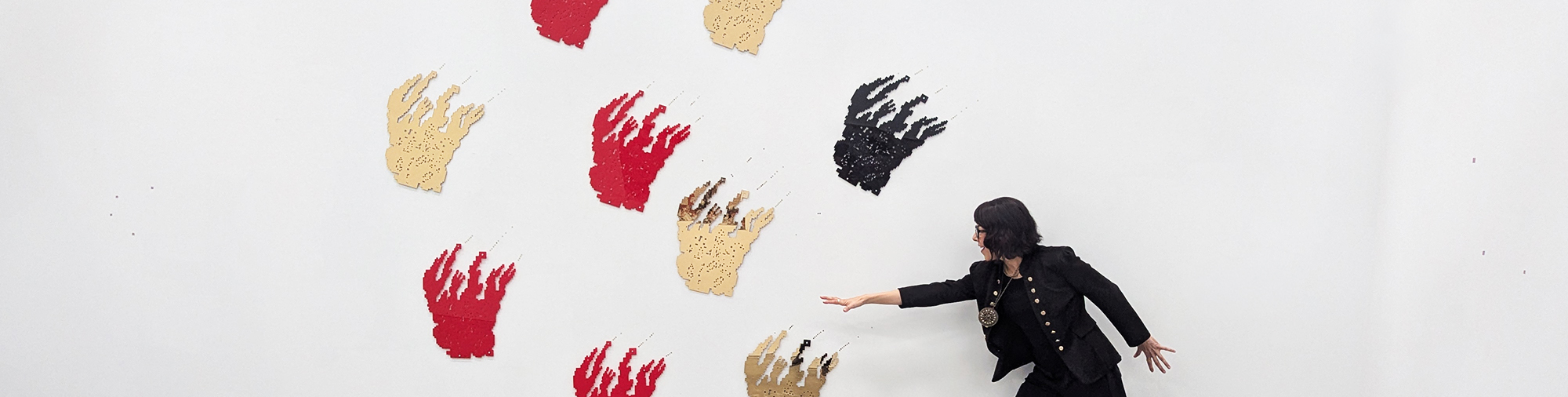
Since 2024, her work has evolved through I Will Rise in Slow Accession. This ongoing project reimagines women from classical Persian paintings as action-figure guardians. It weaves together contemporary narratives and her research into medieval scientific manuscripts, creating an evolving mythological world that extends across multiple forms and media.
Biography
Pantea Karimi has been based in San Jose, California, since 2005 and previously resided in England (2001-2005) and Iran. Karimi’s mother, a history teacher, sparked her early interest in art and history, while her grandmother, the family herbalist, instilled a lifelong connection to botany. Her father, a mathematician and architect, inspired her fascination with mathematics and geometry. At age fourteen, she began formal training in fine arts and classical music alongside general sciences in post-revolutionary Iran. This interdisciplinary foundation shaped her trajectory and eventually led her toward art and design rather than science.
Karimi holds two Master’s Degrees in Graphic Design and Fine Arts from Iran and the U.S., as well as a printmaking degree from the UK. She has been researching medieval scientific and literary manuscripts since 2014 in prominent libraries, including the British Library, the Chester Beatty in Ireland, the Massachusetts Institute of Technology (MIT), and the University of California, San Francisco Library, among others.
Karimi’s works have been exhibited in solo, group, and traveling exhibitions in Iran, Algeria, Germany, Croatia, Mexico, the UK, and the United States, including Minnesota Street Project Foundation Studio Program, San Jose City Hall, San Jose Tech Interactive, San Jose Institute of Contemporary Art, New Bedford Art Museum in Massachusetts, Montefiore Einstein in NY, Rotch Library at MIT, and The San Diego Museum of Art and McMullen Museum of Art in Boston as part of 2024 PST ART: Art & Science Collide, represented by the Getty.
Karimi’s works are held in both private and public collections, including YouTube HQ, Stanford University, the University of California, San Francisco, the University of California, Davis, and the permanent collections of the Cities of Palo Alto and Berkeley (CA). KQED Arts & Culture published an article on Karimi’s 2022 Woman, Life, Freedom work, followed by a live interview on KQED Forum, aired on April 26, 2023.
Karimi is a 2024 City of San Jose Creative Ambassador, a 2023 Kala Art Institute Honoree, and a 2019 Silicon Valley Artist Laureate. She is the recipient of Pollock-Krasner Foundation Artist Grant (2022), City of San Jose Arts and Cultural Exchange Grant (2019) and Artist Residencies and Fellowships at Minnesota Street Project Foundation Studio Program (2026), MASS MoCA (2022 and 2024), Santa Fe Art Institute (2024), Montalvo Art Center’s Lucas Artist Program (2024-2026), University of California San Francisco Library (2021-2022) and Kala Art Institute (2017).
Karimi is an Adjunct Faculty member at Cabrillo College, Aptos, CA, and a member of the international discussion group, Substantial Motion Research Network (SMRN), affiliated with Simon Fraser University in Canada, founded by Dr. Azadeh Emadi and Dr. Laura U. Marks.
Photos at Minnesota Street Project Foundation, San Francisco, CA, 2026